
Trump Phone Review: Why Everyone’s Talking About It—and What You Need to Know Before Buying
FIND THIS Trump phone free on AMAZON
Trump phone review: it sucks. That’s the blunt conclusion The Verge’s news editor Dominic Preston arrives at after a year of reporting, rumors, and unanswered questions, and now—finally—hands-on time. The device has been teased as a brash alternative to mainstream flagships, a symbol product meant to be louder than it is subtle. But the first minutes with it reveal a more familiar story: an undercooked phone wrapped in marketing. It’s not that it fails one big test; it fails lots of small ones, constantly. The experience is less “bold new challenger” and more “unfinished prototype that escaped into the wild.”
Preston’s long reporting trail set expectations in a strange place. The phone was talked up with confident claims, heavy on identity and light on specifics. When you track something for a year, you expect at least a coherent point of view: either premium hardware, bargain pricing, or distinctive software. Instead, the Trump phone lands as a confused mash-up. The build feels cheap in the hand, with plastics that creak when pressed and seams that don’t align cleanly. The buttons wobble. The screen is bright enough indoors but falls apart outside, where reflections and weak peak brightness make it frustrating.
Performance is where the “it sucks” verdict becomes hard to argue with. Day-to-day use is stuttery, and not in the occasional way that budget phones sometimes are—more like the system is constantly catching its breath. App switching is slow, animations hitch, and typing can lag just enough to make you mistrust every word you enter. Heat management is poor: short bursts of camera use or downloading updates make the back warm quickly. Battery life is inconsistent too, dropping fast with light use, then oddly stabilizing later, suggesting sloppy power tuning rather than predictable efficiency. It’s the kind of phone that makes you stop using it.
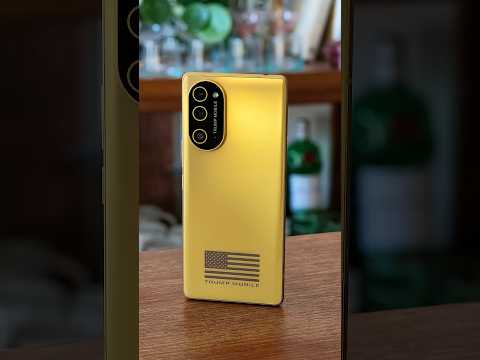
The camera is the most obvious mismatch between promise and reality. In bright light it can capture something usable, but even then the processing is heavy-handed—skin tones look waxy, edges appear over-sharpened, and highlights blow out with little warning. Move indoors and it unravels: shutter delay increases, blur becomes common, and noise reduction smears away detail. Night shots are worse, with the kind of murky, watercolor look that was unacceptable years ago. Video feels unstable and soft, with audio that clips easily. If a phone is meant to be a daily companion, the camera is often the proof, and here the proof is unflattering.
Software doesn’t rescue the package. The interface looks like a skinned version of something generic, with odd translations, inconsistent menus, and preloaded apps that feel like filler. Notifications behave unpredictably, with delayed pushes and occasional duplicates. Settings are scattered, and small quality-of-life features you take for granted—reliable biometric unlock, solid keyboard behavior, clean background task management—feel compromised. Even when it “works,” it doesn’t feel trustworthy. Preston’s year of reporting suggests a product built to make noise; the software suggests a product built in a hurry. That combination leaves users holding the consequences.
So why does it matter? Because this isn’t merely a bad phone; it’s a case study in how branding can try to substitute for engineering. The Trump phone seems designed to sell an idea first and deliver a device second. For some buyers, the symbolism may be the point, but the moment you need it to be a phone—calls, maps, messages, photos, payments—it becomes a liability. Preston’s conclusion lands with the bluntness of earned fatigue: after a year chasing the story, the hardware finally arrives, and it’s not a revelation. It’s just disappointing, loudly, repeatedly, and predictably.
0 Response to "Trump Phone Review: Why Everyone’s Talking About It—and What You Need to Know Before Buying"
Post a Comment